 NVDL
You can use public Jensen Huang statements as an input to an NVDL trading analysis, but the speaker’s identity is not a sufficient trading rule. Verify the statement, establish what is new and specify how it changes a measurable assumption before considering the order.
A useful rule must also permit no trade. If the source is incomplete, the information is already priced or the account cannot manage the exposure, forcing a position adds risk without repairing the information gap. This guide builds an evidence process, not a validated profitable strategy.
Decide what counts as an eligible statement
Define the accepted source before the headline arrives. An official release, full event recording or formal filing offers a different evidentiary basis from a cropped clip, translated caption or anonymous repost. Save the original source rather than only its summary.
The NVIDIA investor-relations site and official event materials are useful starting points. They establish company communication, but forward-looking statements still require qualification and later evidence. Official publication is not a guarantee of the future outcome described.
Exclude a candidate if the relevant wording cannot be verified. A rule that admits uncertainty whenever a headline appears favorable is not a consistent source filter. The exclusion should be recorded so later review does not consider only the statements that produced trades.
Check novelty against a dated baseline
Store the earlier guidance, roadmap or role description alongside the new statement. Identify the actual change: a new numerical outlook, a revised milestone, a confirmed availability stage or a formal governance decision. A more enthusiastic description of an unchanged plan may not meet the rule.
A baseline also prevents historical quotations from being presented as current catalysts. Search the original date and compare the complete context. A newly uploaded video can contain an older speech, and an updated article can recycle a statement first published weeks earlier.
If the thesis relies on a market expectation rather than a company’s prior statement, identify the expectation dataset and capture it before the event. Reconstructing consensus from the subsequent price move makes the rule depend on hindsight.
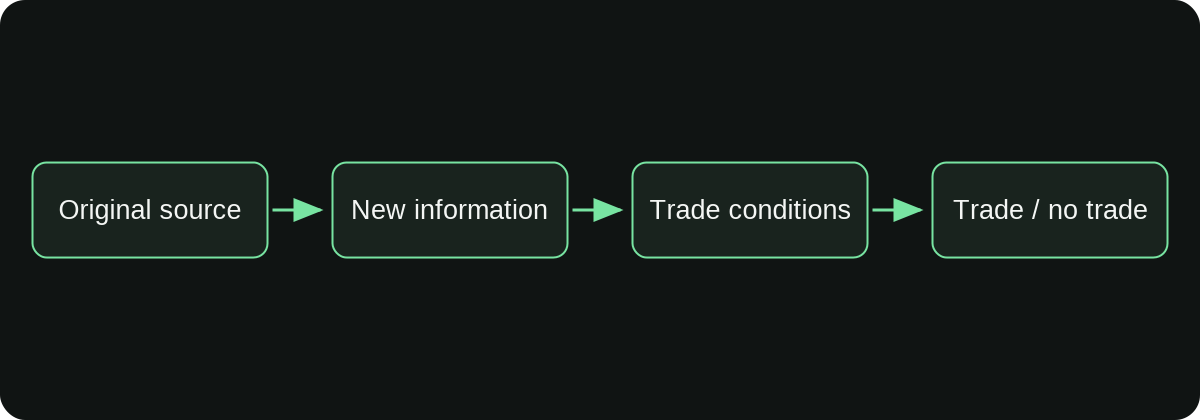
Turn interpretation into an observable condition
An evidence rule should say which assumption changes and what would count against the interpretation. “Huang sounded confident” is difficult to test consistently. A documented change in a specified business measure or milestone is more observable, though its investment effect remains uncertain.
Separate the information condition from the trade condition. A verified positive development can pass the first filter while the available entry price, spread or portfolio concentration makes the trade unattractive. Authentic information does not require an automatic purchase.
Do not invent numerical thresholds merely to make the system look precise. If a threshold is proposed, explain its rationale and test it with data that was not used to select it. The number is a strategy assumption, not a fact established by the statement itself.
Verify timing without claiming an automatic speed advantage
Record when the statement became public, when the source was observed and when an order could actually have been submitted. These are different timestamps. A retail reader should not assume a durable advantage simply because a push notification arrives quickly.
Market participants may react before a summary reaches the trader. The price visible during preparation can change before execution. A test that assumes a fill at the pre-announcement close after reading the announcement would create an impossible information advantage.
If the relevant market is unavailable or NVDL is not eligible for the intended session, record that constraint. Do not substitute a price from another instrument or a derivative venue and call it a feasible ETF-share trade.
Apply the product and account gates
NVDL’s daily leveraged design remains relevant even when the information filter is strong. Define the intended holding interval, review condition and dollar loss capacity. The rule must account for the possibility that a correct business view produces an adverse market response.
Check live order permissions, quote quality and outstanding instructions. The broker comparison explains why an available ticker page does not establish access to every order type or session. A rejected or partially filled order changes the actual position.
The rule should also distinguish an alert from an automated execution. If the process requires a person to confirm context, a notification alone does not complete the task. If automation is contemplated, validate its source handling, duplicate detection and failure behavior before relying on it with capital.
Test the complete rule rather than selected winners
Use an event dataset that includes eligible statements, rejected candidates and no-trade decisions. Preserve what was public at the time. A test made from memorable successful speeches will overstate how easy the selection process was.
Specify entries, exits, costs, gaps and unfilled orders. Compare the proposed rule with an appropriate alternative under the same conventions. Report drawdowns and loss concentration, not only win rate or a selected example of a large gain.
There is no such validated strategy record in this article. The November return example is a historical case that clarifies measurement. One rally cannot establish the expected performance of a broader statement-based rule.
Keep the decision record auditable
A compact record includes the source, original wording, prior baseline, novelty finding, interpretation, rejected alternatives and actual execution. If a statement is later corrected, attach the correction with its timestamp rather than deleting the earlier evidence.
Review whether the mistake was source quality, interpretation, pricing or execution. Different failures need different changes. Adding another indicator will not correct a misquoted statement, and faster alerts will not make a weak business inference sound.
The practical answer is conditional: public statements can inform a trade, but only a complete, tested process can support claims about a repeatable strategy. The choice to remain out of the trade is part of that process, not a failure to act on every prominent headline.
Frequently asked questions
Does quoting exact words remove the need for context?
No. A quotation can still omit a condition, time horizon or question that changes its meaning. Preserve enough of the original exchange to interpret the statement accurately, especially when numbers or future milestones are involved.
Can an AI summary serve as the original source?
It can help locate or organize material, but verify material claims against the recording, release or filing. A confident summary can introduce omissions or errors, and repeating its wording does not establish the underlying fact.
Should I count a no-trade decision in the strategy record?
Yes. It helps show how the eligibility and execution filters actually operate. Excluding those observations can make the selection rule appear simpler and more successful than the full decision process supports.