 NVDL
An AI chip reveal can influence NVDL if it changes NVIDIA expectations and market pricing, but a stronger technical claim does not guarantee an upward trend. Evaluate what was measured, when customers can use the product and whether the stock response supports the specific trade being considered.
This article concerns the interpretation of a chip announcement and a short-term price thesis. The separate roadmap article tracks product-cycle milestones. Here the task is to avoid turning a performance slide or a brief price jump into a claim of proven commercial success or a durable trading trend.
Decode the benchmark before interpreting the business impact
A performance number needs a workload, comparison baseline and test conditions. Training, inference throughput, latency, energy use and system cost answer different questions. A gain in one measure does not establish the same gain in every customer task.
Check precision, model size, batch conditions, software stack and whether the comparison concerns one processor or an entire system. A headline can omit changes that make two results less comparable than they appear. If the source does not disclose enough detail, retain that limitation.
Distinguish a vendor benchmark from an independent measurement. The former can be informative without being neutral or universally reproducible. Do not label a claim independently tested unless the relevant independent work has actually been reviewed.
Separate product status from claimed capability
NVIDIA’s March 16, 2026 Vera Rubin announcement described seven chips in full production. That supports a dated statement about the company’s announced platform status. It does not make every possible configuration, deployment or comparative performance claim interchangeable.
A product can be technically compelling while adoption depends on power, cooling, software integration, networking or customer budgets. Availability in one channel does not establish that all customers can deploy the same system immediately.
Record these dependencies before assigning an earnings impact. A forecast should explain which customers, quantities, timing and economic assumptions it uses. Multiplying a claimed benchmark advantage by current revenue would not provide a defensible estimate.
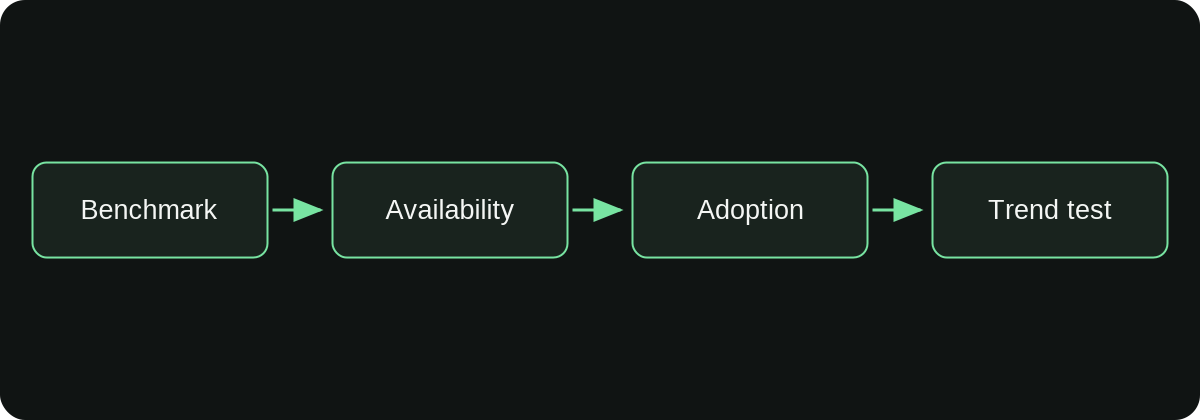
Identify what is actually new to investors
Compare the reveal with the earlier official roadmap and specifications. An event may introduce a new architecture, clarify an existing one or demonstrate a previously announced feature. Only the first-public information should be treated as new evidence at that moment.
If a number was already public, a renewed discussion can still attract trading attention, but that is a different mechanism from a new fundamental disclosure. State the distinction instead of treating every popular clip as the original reveal.
The official GTC materials help establish the source context. Preserve the date and complete qualifications. An excerpt that removes the workload or comparison baseline can change the investment interpretation substantially.
Define a short-term trend test before seeing the result
A test needs a start observation, end observation, session convention and rule for what would weaken the view. “The trend turned bullish after the reveal” is incomplete without those definitions. Selecting the lowest prior price and highest later price creates a hindsight illustration, not a tradable rule.
Use a price series with appropriate corporate-action adjustments and identify whether returns include distributions. If comparing NVIDIA or NVDL with a semiconductor benchmark, align the intervals and explain the benchmark’s different holdings and leverage.
A relative-return difference is descriptive, not automatically risk-adjusted alpha or proof of causation. Sector-wide news, interest rates and unrelated company developments can overlap with the reveal. A proper conclusion should preserve those competing explanations.
Observe the sequence rather than the most dramatic print
A strong opening, a brief intraday high and a strong closing result are different observations. If the trade is intended to last beyond the first session, inspect subsequent daily behavior rather than assuming the initial reaction will persist.
The earnings-window example shows how a positive gap can coexist with a negative regular session. The same measurement discipline applies to a product reveal even though the business content differs.
Do not infer that a reversal proves the technology claim false. Prices respond to expectations and valuation, while technical capability has its own evidence. Likewise, a rally cannot independently validate a benchmark or prove that customers will adopt the product at the assumed economics.
Translate the view into the actual NVDL structure
NVDL’s daily target references NVIDIA stock, not the chip’s benchmark improvement. A twenty-percent performance claim does not imply a forty-percent ETF return. The stock market is an intermediate valuation process, and the investor’s holding interval adds another layer.
For multi-day exposure, repeated returns and costs matter. For an intraday entry after a gap, the relationship to a subsequent stock move need not equal the headline multiplier. The interval-ratio guide explains that distinction with a stated model.
Choose orders using current quotes and broker rules. A technically sound interpretation can still become an unfavorable trade if the price has already moved or liquidity is poor. No numerical support, resistance or entry level is invented here without a verified dataset and method.
Specify the next piece of evidence
After the reveal, identify what would improve or weaken the case: clearer benchmark details, availability confirmation, deployment evidence or later financial disclosure. Do not substitute an unrelated favorable AI headline for the missing proof.
A short-horizon position may end before commercial evidence arrives. In that case, describe the trade as a market-reaction thesis rather than a validated product-adoption thesis. Keeping those purposes distinct prevents a failed short-term setup from being silently converted into a long-term technology conviction.
The useful outcome is a falsifiable interpretation with known limits. A chip reveal can be relevant and exciting while its price effect remains uncertain. Neither a presentation nor a chart removes the need to manage daily leveraged exposure.
Frequently asked questions
Can better energy efficiency mean lower NVIDIA revenue per customer?
It depends on pricing, volume and customer demand. Efficiency can change the economics in several directions; the benchmark alone does not determine revenue. Analyze the commercial assumptions rather than assuming every technical improvement translates proportionally into sales.
Does a customer demonstration prove a broad production rollout?
Not by itself. A demonstration can involve limited hardware, selected conditions or a pilot. Verify the stated deployment scope and timing before extrapolating to the wider customer base.
Should I discard a test if a simultaneous macro event occurred?
Not necessarily, but record the overlap and narrow the causal conclusion. A descriptive price observation can remain useful while the claim that the chip reveal alone produced it remains unproven.