 NVDL
Alternatives to NVDL include direct NVIDIA shares, another daily leveraged NVIDIA ETF, a semiconductor fund and options-based exposure. They solve different problems. The right comparison begins with ownership, time horizon and loss mechanics rather than a ranking of recent returns.
If the goal is long-term participation in NVIDIA’s business, daily leverage may add an unnecessary mismatch. If the goal is a short directional trade, an alternative still requires careful attention to costs, execution and the conditions under which the position can lose.
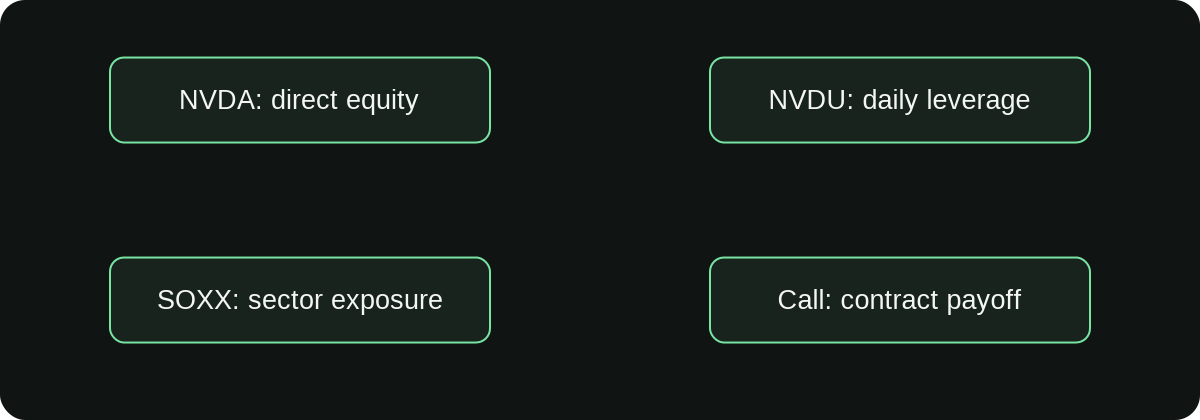
Route one: direct NVDA shares
Buying NVIDIA common stock creates direct company equity exposure rather than ownership of a fund pursuing a daily multiple. There is no ETF-level daily reset imposed on that stock holding. Company performance, valuation and market conditions still create substantial risk.
A direct share position also differs from NVDL in shareholder rights and corporate-payment treatment. The NVIDIA investor-relations site provides company disclosures for that analysis. Do not assume an ETF distribution duplicates the corporate dividend or the rights of holding the underlying shares.
Compare equal dollars, not equal share counts. A fully paid direct holding normally has a different initial exposure from the same dollar amount in a daily-2x fund. Borrowing to enlarge the stock position introduces another financing and account-risk structure rather than recreating a costless version of the ETF.
Route two: NVDU for a similar daily objective
The Direxion NVIDIA product page identifies NVDU’s positive daily-2x objective. It is therefore a closer objective comparison with NVDL than a fund following a different company or sector.
That similarity does not eliminate daily compounding or guarantee identical results. Compare current prospectus costs, separately described financing, actual bid-ask conditions and broker access. A lower headline expense ratio is only one input, particularly for a short holding.
NVDU is not a remedy for a plan that cannot tolerate daily leverage. The underlying task remains the same type of short-horizon amplified exposure. See the single-stock peer comparison before treating another ticker as a fundamentally different investment role.
Route three: a semiconductor fund
A sector fund can provide exposure to several semiconductor businesses instead of concentrating solely on NVIDIA. For example, the iShares Semiconductor ETF factsheet describes SOXX as tracking an equity index of semiconductor-sector companies.
This changes the investment thesis. Returns depend on the fund’s holdings, weights and index methodology, not only NVIDIA’s results. The portfolio may retain material NVIDIA exposure, and sector diversification is not the same as diversification across the whole economy.
Inspect the latest holdings rather than inserting a permanent NVIDIA percentage from an old article. Index composition and weights can change. Also distinguish a conventional sector fund from a leveraged sector product; similar semiconductor branding can conceal a different reset and risk structure.
Route four: a defined option position
A purchased call can provide bullish exposure with an expiration and strike rather than an ETF’s daily reset. Its value depends on the stock price, time remaining, implied volatility and contract terms. A correct directional view can still lose if the move is too small or too late.
The premium paid for a simple long call is at risk, with fees and subsequent exercise-related obligations requiring attention. Do not generalize that risk description to spreads, uncovered options or a stock position created by exercise. Those structures can have different loss and funding consequences.
Options are therefore not an automatic beginner replacement for NVDL. Read the SEC options introduction, applicable disclosures and broker permissions. A comparison needs the actual contract, price and intended exit rather than the statement that both instruments can amplify a bullish view.
Compare the routes on the same decision sheet
Record the intended job, holding interval, amount committed, source of leverage and event that would end the position. Then review how each route can fail. A structure that looks attractive under one assumed path may introduce a different failure condition under another.
| Route | Main exposure distinction | Question to resolve |
|---|---|---|
| NVDA shares | Direct company equity | Can the portfolio absorb company concentration without daily amplification? |
| NVDU | Similar daily leveraged objective | Are implementation and trading terms preferable for the actual order? |
| Semiconductor fund | Multiple companies under an index or mandate | Does the wider sector exposure match the investment thesis? |
| Purchased call | Contract payoff with strike and expiration | Is the timing and volatility-price risk understood and funded? |
NVDL’s own prospectus remains the baseline for comparison. Avoid describing every alternative as safer: a different structure can reduce one problem while introducing another. The SEC single-stock ETF guidance helps distinguish fund packaging from underlying concentration.
Include the cost of changing positions
Selling one position and buying another can create spreads, fees, tax consequences and a period with unintended exposure. Check existing orders and actual fills before assuming the replacement is complete. A partial sale can leave more NVIDIA-linked risk than planned.
For taxable accounts, potential loss-deferral issues need separate review. A different ticker is not by itself a universal wash-sale safe harbor. The US tax guide explains the recordkeeping questions without making an individual determination.
Do not switch simply to make a past loss disappear from the visible position line. A new holding has its own forward-looking case. Evaluate it independently rather than assuming it owes the account a recovery.
Keep the choice connected to the real constraint
If monitoring time is the problem, another actively managed trade may not solve it. If concentration is the problem, a similar NVIDIA leveraged ETF may leave it intact. If capital preservation for near-term expenses is the priority, a bullish instrument comparison may be the wrong starting task.
Remaining uninvested in this particular theme is also a possible outcome of the review. It avoids forcing a product choice when the objective or loss capacity is unresolved. That decision has opportunity and purchasing-power considerations of its own, but it does not require inventing a suitable leveraged route.
The comparison should end with a reason grounded in purpose and constraints. No universal winner is established by the products listed here, and no alternative removes the need for current documents and an executable account-level plan.
Frequently asked questions
Is a covered-call income ETF equivalent to bullish NVIDIA exposure?
Not necessarily. An option-income strategy can exchange some upside participation for option premiums and follows its own holdings and distribution policy. Read the strategy rather than assuming a high payout preserves the same payoff as stock or daily leverage.
Can an inverse NVIDIA fund substitute for a bullish alternative?
It changes the direction of the intended exposure. That may serve a different view or a carefully analyzed hedge, but it is not a bullish replacement simply because it references the same company.
Does owning both NVDA and NVDL create diversification?
It adds two instruments with a shared company driver rather than two independent businesses. Measure the combined exposure and its leverage instead of counting the tickers as separate sources of diversification.